
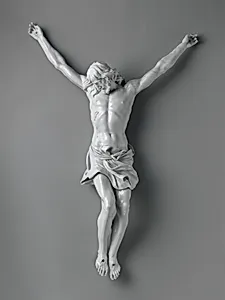
Corpus from a crucifix
Medium
Hard-paste porcelain
Dimensions
Overall (confirmed): H. 26 1/2 x W. 17 x D. 4 9/16 in. (67.3 x 43.2 x 11.6 cm)
Classification
Ceramics-Porcelain
Culture
Italian, Florence
Department
European Sculpture and Decorative Arts
Museum
Metropolitan Museum of Art, New York, NY
Credit
Purchase, Lila Acheson Wallace Gift, 1992
Accession Number
1992.134
Rights
Public Domain
Tags
Art Historical Context
This striking *Corpus from a Crucifix*, crafted around 1745–50 by thecia Porcelain Manuf in Florence, Italy, exemplifies the height of 18th-century European porcelain artistry. Attributed to the collaborative talents of sculptor Massimiliano Soldani, known for his intricate bronze work, and modeler Gaspero Bruschi, the piece measures an impressive 26½ inches in height, making it a monumental example of hard-paste porcelain. Produced at the innovative Doccia factory founded by Marchese Carlo Gin in 1735, it represents Italy's ambitious entry into the elite world of true porcelain production, rivaling Saxony's Meissen. The hard-paste porcelain medium—fired at high temperatures for exceptional durability and translucency—was revolutionary for religious sculpture, traditionally carved in wood or marble. Here, the detailed modeling of Christ's suffering form captures the emotional intensity of the Crucifixion, with finely rendered anatomy, drapery, and expressions that evoke Baroque pathos while embracing Rococo elegance. Doccia's output often drew from classical and religious motifs, blending technical virtuosity with devotional fervor for ecclesiastical and aristocratic patrons. Housed in The Metropolitan Museum of Art, this corpus highlights Florence's Renaissance legacy evolving into Enlightenment-era craftsmanship, inviting visitors to marvel at porcelain's versatility in conveying profound spiritual themes.
About the Artist
Doccia Porcelain Manufactory|Massimiliano Soldani|Gaspero Bruschi · 1737–1896
The Doccia Porcelain Manufactory, founded in 1737 by Marquis Carlo Ginori near Florence, holds the distinction of being Italy's first hard-paste porcelain manufacturer and one of the few European porcelain enterprises to survive from the eighteenth century to the present day without interruption. Unlike most contemporary ventures — which depended on the patronage and protection of ruling courts — ...