
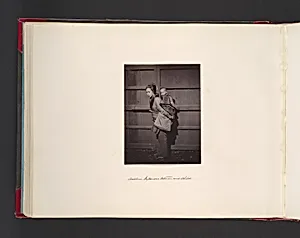
Costume Japanese Woman and Child
1865
Medium
Albumen silver print from glass negative
Dimensions
17.4 × 13.5 cm (6 7/8 × 5 5/16 in.)
Classification
Photographs
Department
Photographs
Museum
Metropolitan Museum of Art, New York, NY
Credit
Gilman Collection, Purchase, Cynthia Hazen Polsky Gift, 2005
Accession Number
2005.100.583 (66b)
Rights
Public Domain
Art Historical Context
In 1865, Scottish photographer John Thomson captured *Costume Japanese Woman and*, a poignant albumen silver print from glass negative, now housed in the Metropolitan Museum of's Gilman Collection. Measuring a modest 17.4 × 13.5 cm, this intimate photograph depicts a Japanese woman and child in traditional attire, likely during Thomson's travels through Japan amid the waning Edo period. As one of the earliest Western photographers to document East Asia extensively, Thomson's work bridged, offering Victorian audiences glimpses into everyday Japanese life just before the transformative Meiji Restoration of 1868. The albumen process, the gold standard of mid-19th-century photography, lent these images their signature warm sepia tones and exquisite detail, achieved by coating paper with egg-white emulsion and exposing it to silver salts via a glass negative. This technique allowed Thomson to preserve the intricate textures of kimonos and hairstyles with remarkable clarity, turning ethnographic portraiture into high art. His style blended documentary precision with an eye for human dignity, influencing later travel photography. This piece highlights a pivotal moment of cultural exchange, as Japan cautiously opened to the world, making Thomson's image a treasured window into vanishing traditions. Visitors, imagine the quiet pride in their poses—timeless ambassadors of heritage.
About the Artist
John Thomson · 1837–1921
John Thomson (1837–1921), a pioneering Scottish photographer, was born on 14 June 1837 in Edinburgh as the eighth of nine children to William Thomson, a tobacco spinner and trader, and Isabella Newlands.) After schooling in the early 1850s, he apprenticed with a local optical and scientific instrument manufacturer, where he mastered the principles of photography, completing his training around 185...