
Costume Ornament
Unknown Artist
11th–12th century
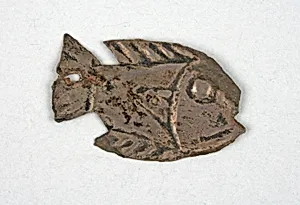
Medium
Silver
Dimensions
L. 1 3/8 in. (3.5 cm)
Classification
Metal-Ornaments
Culture
Central coast (?)
Department
Arts of Africa, Oceania, and the Americas
Museum
Metropolitan Museum of Art, New York, NY
Credit
Gift of Mr. and Mrs. Nathan Cummings, 1964
Accession Number
64.228.268
Rights
Public Domain
Tags
Art Historical Context
This delicate silver Costume Ornament, dating to the 11th–12th century, hails from a central coastal culture—possibly along the shores of Africa, Oceania, or the. Measuring just 1 3/8 inches (3.5 cm) in length, it was likely worn as a pendant or brooch, adorning garments for personal adornment or status display. The fish motif, evoked by its tag, reflects the vital role of marine life in coastal societies, where such symbols often carried protective or fertility meanings tied to the sea's bounty. Crafted in silver, a precious metal valued for its luster and malleability, the ornament showcases the sophisticated metalworking techniques of its era. Artisans would have hammered, cut, and possibly chased the soft metal into this compact form, demonstrating precision in an age before modern tools. Its small scale highlights the portability and intimacy of personal jewelry in pre-modern cultures. Now part of the Metropolitan Museum of Art's Arts of Africa, Oceania, and the Americas collection—thanks to a 1964 gift from Mr. and Mrs. Nathan Cummings—this piece offers a glimpse into ancient coastal life, bridging everyday wear with symbolic artistry. Visitors are invited to imagine it glinting on a tunic amid ocean breezes.