
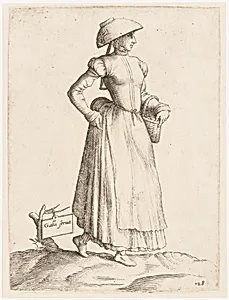
Costume Plate: Galla Serva
ca. 1557–58
Medium
Engraving
Dimensions
sheet: 6 x 4 7/16 in. (15.2 x 11.3 cm)
Classification
Prints
Department
Drawings and Prints
Museum
Metropolitan Museum of Art, New York, NY
Credit
Harris Brisbane Dick Fund, 1953
Accession Number
53.600.835
Rights
Public Domain
Tags
Art Historical Context
Enea Vico’s *Costume Plate: Galla Serva* (ca. 1557–58) is a finely detailed engraving that captures the Renaissance fascination with recording dress from different cultures and historical periods. Created by the Italian printmaker Enea Vico, the work belongs to a tradition of costume books that emerged in the mid-sixteenth century, when European artists and scholars sought to document clothing as a means of understanding social customs, rank, and geography. The modest sheet size—roughly six by four inches—made such prints easy to collect and study, allowing viewers to compare attire across regions and eras. As an engraving, the medium allowed Vico to render intricate folds of fabric, jewelry, and accessories with remarkable precision. This technical clarity helped transform costume studies from simple sketches into widely circulated reference tools for artists, tailors, and antiquarians. The subject, identified as a “Galla Serva,” likely represents a woman from ancient Gaul or a related northern European context, reflecting the period’s interest in classical and ethnographic themes. Today, the print offers a window into how sixteenth-century Europeans visualized identity through clothing. Its presence in the Metropolitan Museum’s collection underscores the enduring value of these small engravings as both artistic achievements and historical documents.
About the Artist
Enea Vico · 1523–1567
Enea Vico (1523–1567) was born in Parma and came of age during the final, energetic decades of Italian Renaissance printmaking. By 1541 he had made his way to Rome, where he entered the orbit of the engraver and publisher Tommaso Barlacchi and began his professional career. In Rome, Vico encountered the work of the most celebrated printmakers of the preceding generation—Marcantonio Raimondi, Agost...