
Costume Plate: German Messenger
ca. 1558–70
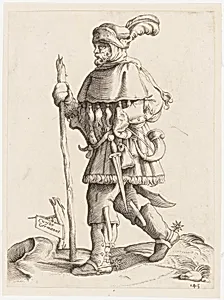
Medium
Engraving
Dimensions
Sheet (trimmed to edge): 5 7/8 × 4 7/16 in. (14.9 × 11.2 cm)
Classification
Prints
Department
Drawings and Prints
Museum
Metropolitan Museum of Art, New York, NY
Credit
Harris Brisbane Dick Fund, 1953
Accession Number
53.600.838
Rights
Public Domain
Tags
Art Historical Context
Created around 1558–70 by the Italian engraver Enea Vico, *Costume Plate: German Messenger* belongs to the Renaissance fascination with recording regional dress and social roles. At just under six inches tall, this small engraving captures a standing male figure equipped with weapons, reflecting the era’s interest in military messengers who traveled between courts and battlefields. Such plates often appeared in printed series that documented the costumes of Europe, helping viewers visualize distant lands and professions. Vico’s precise engraving technique excels at rendering the textures of fabric, leather, and metal, allowing fine lines to convey both the messenger’s functional attire and his authoritative stance. Produced during a time when printed images circulated widely, works like this served as both educational tools and artistic records, preserving details of 16th-century German dress for audiences across Italy and beyond. Today it offers a vivid glimpse into how Renaissance artists blended observation with imagination to map cultural identity.
About the Artist
Enea Vico · 1523–1567
Enea Vico (1523–1567) was born in Parma and came of age during the final, energetic decades of Italian Renaissance printmaking. By 1541 he had made his way to Rome, where he entered the orbit of the engraver and publisher Tommaso Barlacchi and began his professional career. In Rome, Vico encountered the work of the most celebrated printmakers of the preceding generation—Marcantonio Raimondi, Agost...