
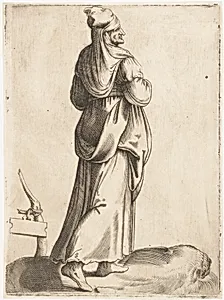
Costume Plate: Peasant Woman from Spain
ca. 1555–58
Medium
Engraving
Dimensions
Sheet (trimmed to plate): 6 in. × 4 1/2 in. (15.3 × 11.4 cm)
Classification
Prints
Department
Drawings and Prints
Museum
Metropolitan Museum of Art, New York, NY
Credit
Gift of Harry G. Friedman, 1958
Accession Number
58.651.48
Rights
Public Domain
Tags
Art Historical Context
Created around 1555– by the Italian engraver Enea Vico, this small yet detailed print belongs to the Renaissance tradition of costume studies that documented regional dress across Europe. Vico, active in Venice and elsewhere, specialized in reproductive engravings that captured the textures of fabric, embroidery, and accessories with remarkable precision. The modest sheet size—roughly postcard dimensions—made such images easy to collect and circulate among scholars, artists, and curious viewers. Costume plates like this one reflected a growing sixteenth-century interest in ethnography and social observation. By depicting a peasant woman from Spain, Vico offered northern European audiences a glimpse of Iberian rural attire, complete with distinctive headwear and layered garments. As an engraving, the work could be printed in multiple impressions, allowing these visual records to spread widely and influence both fashion design and theatrical costume. Today the print resides in the Metropolitan Museum’s Department of Drawings and Prints, a reminder of how early modern printmaking helped shape ideas about cultural identity and everyday life. Its gift to the museum in 1958 continues to let visitors appreciate the delicate line work that once brought distant worlds vividly to life.
About the Artist
Enea Vico · 1523–1567
Enea Vico (1523–1567) was born in Parma and came of age during the final, energetic decades of Italian Renaissance printmaking. By 1541 he had made his way to Rome, where he entered the orbit of the engraver and publisher Tommaso Barlacchi and began his professional career. In Rome, Vico encountered the work of the most celebrated printmakers of the preceding generation—Marcantonio Raimondi, Agost...