
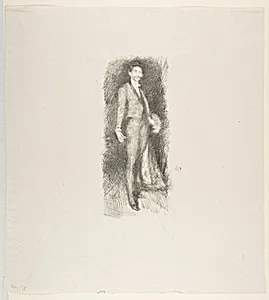
Count Robert de Montesquiou, No. 2
Medium
Transfer lithograph with scraping, drawn on thin transparent transfer paper; only state (Chicago); printed in black ink on grayish ivory China paper
Dimensions
Image: 8 15/16 × 37 13/16 in. (22.7 × 96 cm) Sheet: 14 1/4 × 13 1/16 in. (36.2 × 33.1 cm)
Classification
Prints
Department
Drawings and Prints
Museum
Metropolitan Museum of Art, New York, NY
Credit
Harris Brisbane Dick Fund, 1917
Accession Number
17.3.251
Rights
Public Domain
Tags
Art Historical Context
In 1894, James Mc Whistler, a leading figure in the Aesthetic movement, created *Count Robert de Montesqui, No. 2*, a striking transfer lithograph capturing the aristocratic French dandy, poet, and art critic Robert de Montesquiou. for his emphasis on tonal harmony, subtle color, and "art for art's sake," Whistler portrayed the count in a panoramic, elongated format (nearly 38 inches wide),oking a sense of elegant procession and fin-de-siècle sophistication. This print, part of a rare series, reflects Whistler's fascination with elite Parisian society during his later years in Europe. Whistler's innovative technique shines here: he drew directly on thin, transparent transfer paper, which was then pressed onto a lithographic stone for printing in black ink on delicate grayish ivory China paper. The "scraping" process added texture and luminosity, mimicking the soft, painterly effects of his oils and etchings. As the only known state printed in Chicago, this impression—acquired by The Metropolitan Museum of Art via the Harris Brisbane Dick Fund in 1917—highlights lithography's rise as a democratic yet refined medium in the late 19th century. This work not only showcases Whistler's printmaking mastery but also immortalizes Montesquiou's cultural influence, bridging Symbolism and decadence. Visitors will appreciate its intimate scale against the expansive image, inviting a closer look at an era of refined excess.
About the Artist
James McNeill Whistler · 1834–1903
James Abbott McNeill Whistler (1834-1903) was an American-born painter and printmaker who became a leading figure in the Aesthetic Movement and pioneer of Tonalism and Japonisme. He revolutionized art by championing "art for art's sake" and treating paintings as visual equivalents of musical compositions, titling works as "arrangements," "harmonies," and "nocturnes" to emphasize formal qualities o...