
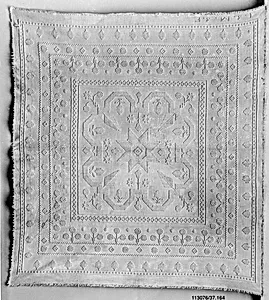
Counterpane, Bolton type
Unknown Artist
ca. 1800–1830
Medium
Cotton, woven
Dimensions
101 x 89 1/2 in. (256.5 x 227.3 cm)
Classification
Counterpane
Culture
British, probably
Department
The American Wing
Museum
Metropolitan Museum of Art, New York, NY
Credit
Gift of Mrs. Courtney Brown, 1937
Accession Number
37.164
Rights
Public Domain
Art Historical Context
This elegant counterpane, a type associated with Bolton, England, dates to around 1800–1830 and exemplifies the artistry of British cotton weaving during the early Industrial Revolution. Woven from cotton, it measures an impressive 101 x 89½ inches, perfectly sized as a bedspread to adorn households of the era. Though the artist remains unknown, the "Bolton type" nods to the Lancashire town's renown as a textile hub, where mechanized looms produced intricate, durable fabrics for export worldwide. The medium's significance lies in its reflection of technological innovation: power looms and Jacquard mechanisms enabled complex patterns in cotton, a fiber revolutionized by British mills after the cotton gin's invention. Likely imported to America, this piece graces The American Wing at The Metropolitan Museum of Art, gifted by Mrs. Courtney Brown in 1937. It highlights transatlantic trade and the spread of British domestic luxury to American homes. As a functional yet beautiful object, the counterpane bridges utility and aesthetics, offering a glimpse into Regency-era comfort and the global cotton economy that shaped modern textiles. Visitors, imagine it draped over a four-poster bed, warming a family's nights amid rapid industrialization.