
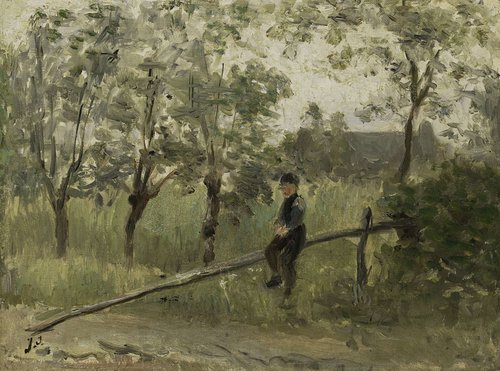
Country Boy on a Pole Barrier
1900 - 1911
Medium
oil on panel
Dimensions
9.5; 37; 28
Rights
Public Domain
About this artwork
buitenmaat: diepte 9,5 cm (drager incl. SK-L-3443)
Art Historical Context
Jozef Israëls, a leading figure of the Hague School, created *Country Boy on a Pole Barrier* during the final decade of his long career. Known for his sensitive portrayals of rural and working-class life, Israëls often turned his attention to the quiet dignity of the Dutch countryside. This small oil on panel, measuring just 28 by 37 centimeters, captures an intimate moment of everyday existence, reflecting the artist’s lifelong interest in humble subjects rendered with warmth and empathy. Painted between 1900 and 1911, the work exemplifies Israëls’ mature technique. Working on panel allowed him to achieve subtle tonal gradations and a soft, atmospheric quality characteristic of late Hague School realism. The modest scale invites close viewing, encouraging visitors to linger over the boy’s relaxed pose and the simple wooden barrier that separates him from the surrounding landscape. Today housed in the Rijksmuseum, the painting offers a poignant glimpse into early twentieth-century Dutch rural culture. Israëls’ sympathetic eye transforms an ordinary scene into a meditation on youth, solitude, and the enduring rhythms of country life, reminding viewers of the quiet beauty found in the most unassuming moments.
About the Artist
Jozef Israëls · 1824–1911
Israëls was born in Groningen to poor Jewish parents. He trained as an artist in Groningen and Amsterdam, and between 1845 and 1855, he expanded his training by travelling to Paris, Dusseldorf, and the artist's colony at Oosterbeek. However, the most influential locations he visited were the Dutch seaside towns of Zandvoort and Katwijk, were he adopted genre painting as a means of documenting the ...