
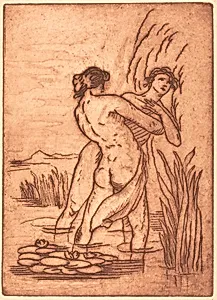
Couple Standing in Water
1915
Medium
etching printed in red on Japanese paper
Dimensions
plate: 27.5 x 19.9 cm (10 13/16 x 7 13/16 in.) sheet: 31.8 x 25 cm (12 1/2 x 9 13/16 in.)
Classification
Department
CG-E
Museum
National Gallery of Art, Washington, D.C.
Credit
Gift of Frank Anderson Trapp
Accession Number
2003.118.3
Rights
Public Domain
Art Historical Context
Émile Bernard's *Couple Standing in Water (1915) is a striking etching printed in vivid red ink on delicate Japanese paper, measuring 27.5 x 19.9 cm on the plate. Created during the tumultuous years of World War I this intimate print captures a pair of figures poised in shallow water, evoking a sense of intimacy and mystery. Bernard, a pioneering French Post-Impressionist and key figure in the Synthetist movement alongside Paul Gauguin and Vincent van Gogh, often explored symbolic and emotional themes in his later works, blending bold outlines with flattened forms reminiscent of his earlier Cloisonnism style. The choice of etching—a meticulous intaglio technique where acid etches lines into a metal plate—allowed Bernard to achieve fine, expressive lines infused with the warmth of red monochrome. Printing on Japanese paper, prized for its soft texture and absorbency, nods to the Japonisme craze that influenced European artists like Bernard in the late 19th and early 20th centuries. This medium enhanced the print's luminous quality, making it a testament to his innovative printmaking amid a shifting art world. Now housed in the National Gallery of Art as a gift from Frank Anderson Trapp (Department CG-E), this work invites visitors to ponder its serene yet enigmatic narrative—perhaps a modern echo of biblical or mythological couples—highlighting Bernard's enduring ability to distill human connection into simple, poetic forms.