
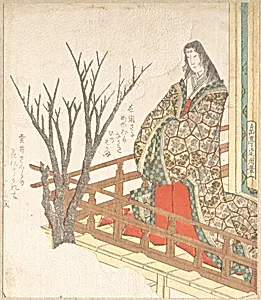
Court Lady Looking at a Blooming Cherry-Tree
19th century
Medium
Woodblock print (surimono); ink and color on paper
Dimensions
7 7/8 x 6 13/16 in. (20 x 17.3 cm)
Classification
Prints
Culture & Period
Japan · Edo period (1615–1868)
Department
Asian Art
Museum
Metropolitan Museum of Art, New York, NY
Credit
H. O. Havemeyer Collection, Bequest of Mrs. H. O. Havemeyer, 1929
Accession Number
JP2061
Rights
Public Domain
Tags
Art Historical Context
In the serene world of Edo-period Japan (1615–8), Yashima Gakutei's *Court Lady Looking at aing Cherry-Tree*19th century) captures a moment of quiet contemplation. This intimate woodblock print, known as a *surimono*, depicts an elegant court lady gazing delicate cherry blossoms, symbols of life's fleeting beauty in Japanese culture. Produced during a time when ukiyo-e prints celebrated the "floating world" of pleasure and transience, Gakutei's work reflects the refined tastes of Kyoto's literati class. Crafted with ink and color on paper, the small-scale print (measuring just 7 7/8 x 6 13/16 inches) showcases *surimono*'s luxurious techniques: fine carving for intricate details, subtle gradations of color (*bokashi*), and often mica or embossing for a tactile shimmer (though not specified here). Gakutei, a poet-designer from the Kyoto school, blended artistry with haiku-like poetry, elevating these privately commissioned prints—typically for New Year's greetings or celebrations—beyond mere decoration. Housed in the Metropolitan Museum of Art's H. O. Havemeyer Collection, this piece invites visitors to ponder *mono no aware*, the pathos of things, as the lady's poised silhouette frames nature's ephemeral bloom. A gem of Asian printmaking, it bridges everyday poetry and profound cultural reverence for cherry blossoms.
About the Artist
Yashima Gakutei · 1786–1868
Yashima Gakutei (c. 1786–1868), born in Osaka as the illegitimate son of a Tokugawa shogunate samurai named Hirata, adopted the name from his mother's subsequent marriage into the Yashima clan. Little is documented about his early years beyond these familial ties, but he pursued artistic training under the esteemed ukiyo-e masters Totoya Hokkei and Katsushika Hokusai, absorbing their precision in ...