
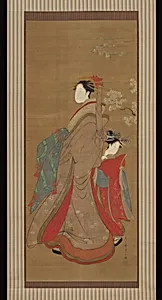
Courtesan and Attendant
18th–19th century
Medium
Hanging scroll; ink and color on paper
Dimensions
36 1/2 x 15 3/4 in. (92.7 x 40 cm)
Classification
Paintings
Culture
Japan
Department
Asian Art
Museum
Metropolitan Museum of Art, New York, NY
Credit
Gift of Edward M. Bratter, 1957
Accession Number
57.70.2
Rights
Public Domain
Tags
Art Historical Context
Chōbunsai Eishi (1756–1829), a master of ukiyo-e—the "pictures of the floating world" genre from Japan's Edo period—created *Courtesan and Attendant* in the late 18th or early 19th century. This hanging scroll captures the elegance of the Yoshiwara pleasure district, where high-ranking courtesans (oiran) embodied beauty, grace, and refined artistry.ishi's bijin-gabeautiful women) style shines here, portraying the women with elongated figures, subtle expressions, and flowing kimonos that evoke the transient pleasures of urban life. Rendered in ink and color on paper—a traditional medium for intimate Japanese paintings—the work showcases Eishi's precise linework and delicate pigmentation. Hanging scrolls like this were prized for private viewing, unrolled to reveal layered compositions that draw the eye from the attendant's supportive poise to the courtesan's poised allure. Vibrant hues and soft shading highlight silk textures and hairstyles, reflecting the period's obsession with fashion and femininity. Housed in the Metropolitan Museum of Art's Asian Art collection (gift of Edward M. Bratter, 1957), this piece offers a window into Edo Japan's vibrant subculture, where art celebrated the ephemeral beauty of courtesans amid societal constraints. Its 36½ × 15¾-inch format invites contemplation of women's roles in a male-dominated world.
About the Artist
Chōbunsai Eishi · 1756–1829
Japanese, 1756–1829