
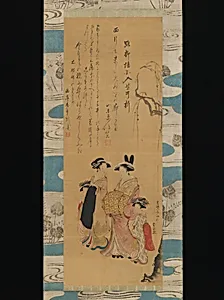
柳下美人図|Courtesan and her Attendants under a Willow Tree
Medium
Hanging scroll; ink, color, and gold on silk
Dimensions
36 1/2 x 13 3/8 in. (92.7 x 34 cm) Overall with mounting: 72 13/16 × 18 7/8 in. (185 × 48 cm) Overall with knobs: 72 13/16 × 20 5/8 in. (185 × 52.4 cm)
Classification
Paintings
Culture & Period
Japan · Edo period (1615–1868)
Department
Asian Art
Museum
Metropolitan Museum of Art, New York, NY
Credit
Mary Griggs Burke Collection, Gift of the Mary and Jackson Burke Foundation, 2015
Accession Number
2015.300.141
Rights
Public Domain
Tags
Art Historical Context
Step into the vibrant world of Edo-period with *Courtesan and her Attendants a Willow Tree* (柳下美人図), a captivating 1796 hanging scroll created the collaborative talents of Unchō, Kyokutei Bakin, and Santō Kyōden. Painted in ink, color, and on silk, this ½ × 13⅜-inch work (92.7 × 34 cm) exemplifies bijin-ga, or "pictures of beautiful women," a popular genre that celebrated feminine grace and elegance. The luxurious medium of silk with gold flecks evokes the opulence of the era's urban pleasure districts, designed for intimate display in a tokonoma alcove. Set against the flowing branches of a willow tree—symbolizing gentle beauty and seasonal transience—the composition portrays a high-ranking courtesan (oiran) surrounded by her attendants, capturing the refined allure of Yoshiwara, Edo's famed entertainment quarter. Santō Kyōden, a master of ukiyo-e ("floating world" imagery), infused the scene with his signature wit and attention to fashion details like elaborate kimonos and hairstyles, while Bakin's literary flair may have influenced the poetic harmony. This artwork reflects the booming merchant culture of the late 18th century, where such scrolls bridged art, literature, and theater. Housed in the Metropolitan Museum of Art's Mary Griggs Burke Collection, it offers a window into Japan's playful yet poignant exploration of beauty amid impermanence, inviting viewers to savor the courtesan's poised charm.
About the Artist
Unchō 雲潮|Kyokutei Bakin 曲亭馬琴|Santō Kyōden 山東京伝 (Japanese| |Japanese) · 1740 |1767 |1761 –1820 |1848 |1816
Japanese, active late 18th century|1767–1848|Japanese, 1761–1816