
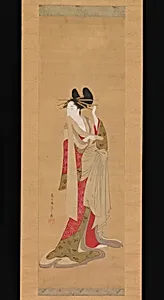
Courtesan with a Letter in Her Mouth
1756–1815
Medium
Hanging scroll; ink and color on silk
Dimensions
Image: 32 1/16 × 10 3/16 in. (81.4 × 25.9 cm) Overall with mounting: 65 1/2 × 14 5/16 in. (166.4 × 36.4 cm) Overall with knobs: 65 1/2 × 16 1/2 in. (166.4 × 41.9 cm)
Classification
Paintings
Culture & Period
Japan · Edo period (1615–1868)
Department
Asian Art
Museum
Metropolitan Museum of Art, New York, NY
Credit
Gift of Florence and Herbert Irving, 2015
Accession Number
2015.500.9.16
Rights
Public Domain
Tags
About this artwork
This hanging scroll; ink and color on silk, created in 1756–1815, represents significant artistic achievement by Chōbunsai Eishi, a Japanese artist. The piece demonstrates the technical capabilities and aesthetic conventions of Japanese art during this historical period. Working in hanging scroll; ink and color on silk, the artist employed materials and techniques characteristic of the era, creating visual effects that convey both subject matter and artistic vision. Museum collections preserve s...
Art Historical Context
In the vibrant world of Edo-period Japan (1615–1868), Chōbunsai Eishi (1756–1815) captured the elegance of the "floating world" with *Courtesan with a Letter Her Mouth*. This hanging scroll, rendered in ink and color on silk, exemplifies ukiyo-e artistry, a genre celebrating beauty, pleasure, and transience. Eishi, renowned for his bijin-ga ( of beautiful women), specialized in graceful depictions of courtesans from Yoshiwara, Tokyo's famed pleasure district. The intimate scale—32 1/16 × 10 3/16 inches—invites viewers into a private moment, where the woman poised with a letter suggests secrets of love and longing. Eishi's refined technique shines through delicate ink lines and subtle color washes on silk, creating a luminous, ethereal quality. Silk's smooth surface allowed for fluid brushwork that emphasized flowing robes and poised gestures, hallmarks of his soft, lyrical style distinct from bolder contemporaries like Utamaro. Hanging scrolls like this were designed for selective display in homes, unrolled for admiration during gatherings, blending art with social ritual. Today, at the Metropolitan Museum of Art, this gift from Florence and Herbert Irving preserves Edo Japan's cultural allure—women navigating desire amid societal constraints. It offers a window into 18th-century aesthetics, where beauty intertwined with ephemerality, inviting us to ponder timeless themes of correspondence and femininity.
About the Artist
Chōbunsai Eishi · 1756–1829
Japanese, 1756–1829