
菱川師宣画 衝立のかげに 遊女と若衆|Courtesan with a Young Man (Wakashu) beside a Screen
ca. 1679–84
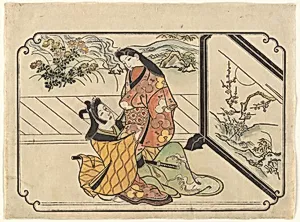
Medium
Woodblock print (sumizuri-e); ink and hand-applied color on paper; horizontal ōban
Dimensions
Image: 10 3/4 × 14 1/2 in. (27.3 × 36.8 cm)
Classification
Prints
Culture & Period
Japan · Edo period (1615–1868)
Department
Asian Art
Museum
Metropolitan Museum of Art, New York, NY
Credit
Gift of Lee E. Dirks, in celebration of the Museum's 150th Anniversary, 2020
Accession Number
2020.195
Rights
Public Domain
Art Historical Context
Step behind the ornate screen in Hishikawa Moronobu *Courtesan with a Young (Wakashu) beside a Screen* (ca. 1679–84), a captivating glimpse into Japan's vibrant "floating world" of the Edo period (1615–1868). Moronobu, a pioneering ukiyo-e master, captures a tender, intimate moment between a glamorous courtesan from the Yoshiwara pleasure district and a stylish wakashu—a fashionable young man with a boy's haircut, often idealized in kabuki theater and urban romance. This woodblock print (sumizuri-e), rendered in bold ink outlines with delicate hand-applied color on paper in the grand horizontal ōban format (10 3/4 × 14 1/2 in.), invites viewers to peek into forbidden pleasures, reflecting the era's booming urban culture amid strict samurai rule. Moronobu's work marks a revolutionary shift in Japanese printmaking: he popularized affordable, single-sheet ukiyo-e, blending dynamic composition with everyday elegance. The sparse color—typically reds and greens—heightens the drama, while intricate patterns on kimonos and the latticed screen showcase his mastery of line and texture. Donated to the Metropolitan Museum of Art in 2020, this print celebrates not just artistic innovation but the cultural allure of Edo's nightlife, where beauty, desire, and transience intertwined. A must-see for anyone exploring Japan's artistic golden age!
About the Artist
Hishikawa Moronobu 菱川師宣 (Japanese) · 1618 –1694
Japanese, 1618–1694