
Courtesans in an Iris Garden
late 18th century
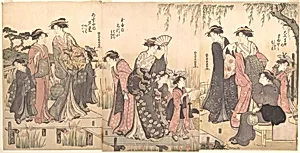
Medium
Triptych of woodblock prints; ink and color on paper
Dimensions
Image (each): 15 × 10 in. (38.1 × 25.4 cm)
Classification
Prints
Culture & Period
Japan · Edo period (1615–1868)
Department
Asian Art
Museum
Metropolitan Museum of Art, New York, NY
Credit
The Howard Mansfield Collection, Purchase, Rogers Fund, 1936
Accession Number
JP2663
Rights
Public Domain
Tags
Art Historical Context
Step into the vibrant world of Edo-period Japan with *Courtesans in an Iris*, a captivating triptych woodblock by Katsukawa Shunch, created in the late 18th century. This work, composed of three panels each measuring 15 × 10 inches, uses ink and color on paper to depict elegant courtesans strolling through a lush iris garden. Shunchō, a prominent ukiyo-e artist the Katsukawa school, in bijin-ga—images of beautiful women—capturing the grace and allure of these figures from the pleasure districts. During Japan's Edo period (1615–1868), woodblock prints like this one brought the "floating world" of urban pleasures to everyday viewers. Affordable and mass-produced, they celebrated the transient beauty of life in Yoshiwara, Edo's famed entertainment quarter, where courtesans embodied sophistication and sensuality. The iris garden evokes summer elegance, with its blooming flowers symbolizing refinement in Japanese culture. Shunchō's technique shines in the precise layering of colors and delicate lines, achieved through collaborative woodblock printing—a revolutionary process that made art accessible. Now housed in the Metropolitan Museum of Art's Asian Art Department (The Howard Mansfield Collection, Purchase, Rogers Fund, 1936), this triptych invites us to savor the artistry of a bygone era's fleeting joys.
About the Artist
Katsukawa Shunchō (Japanese) · 1775 –1795
Japanese, active ca. 1783–95