
Covered Beaker
Unknown Artist
ca. 1325–50 (vessel); ca. 1340–60 (mounts)
Medium
Silver gilt, rock crystal, and translucent enamels
Dimensions
Overall: 8 1/4 x 3 3/8 in. (21 x 8.6 cm)
Classification
Metalwork-Silver
Culture
Italian (vessel); Austrian (mounts)
Department
The Cloisters
Museum
Metropolitan Museum of Art, New York, NY
Credit
The Cloisters Collection, 1989
Accession Number
1989.293
Rights
Public Domain
Art Historical Context
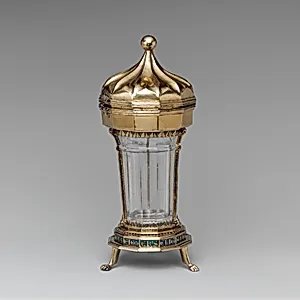
This exquisite Covered Beaker, on view in The Cloisters at the Metropolitan Museum of Art, exemplifies theulence of late medieval craftsmanship. Dating to around 1325–50 for its rock crystal vessel and 1340–60 for the Austrian silver gilt mounts, the piece stands just over 8 inches tall. The translucent body of carved rock crystal—a prized material symbolizing purity and clarity in the Gothic era—reveals subtle internal facets, while the ornate mounts feature intricate chasing and translucent enamels that catch the light with vibrant hues. Crafted as a luxury object, likely for ecclesiastical or aristocratic use, the beaker highlights the artistic dialogue across 14th-century Europe. Italy's mastery of rock crystal cutting paired seamlessly with Austria's expertise in gilded silver and enamelwork, techniques that demanded exceptional skill: enamels were fused in kilns for jewel-like translucency, and gilding added a regal glow. Such hybrid creations were rare treasures, traded along Alpine routes, underscoring the interconnected world of medieval courts. Today, as part of The Cloisters Collection (1989), this beaker invites visitors to ponder the splendor of Gothic metalwork, where form met function in vessels that held wine, relics, or spices—remnants of a vibrant, faith-filled age.