
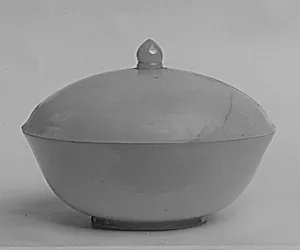
Covered bowl
Unknown Artist
Medium
White jadeite
Dimensions
H. 3 1/8 in. (7.9 cm); Diam. 4 1/4 in. (10.8 cm)
Classification
Jade
Culture & Period
China · Qing dynasty (1644–1911), Qianlong period (1736–95)
Department
Asian Art
Museum
Metropolitan Museum of Art, New York, NY
Credit
Bequest of Edmund C. Converse, 1921
Accession Number
21.175.49a, b
Rights
Public Domain
Art Historical Context
This exquisite covered bowl, crafted from pristine white jadeite during China's Qing dynasty Qianlong period (173695), exemplifies the era's mastery of luxury craftsmanship. Measuring just 3⅛ inches high and 4¼ inches in, its compact form belies the technical precision required to carve such a hard, translucent stone into a functional yet ornamental vessel. Jadeite, prized for its luminous quality and rarity, was reserved for elite objects, symbolizing purity, immortality, and imperial virtue in Chinese culture. The Qianlong emperor, a fervent patron of the arts, oversaw workshops that elevated jade carving to new heights, often imitating archaic bronzes or natural forms while showcasing flawless polishing and intricate detailing. Though the artist remains unknown, this bowl's smooth surfaces and subtle lid finial reflect the period's emphasis on refinement and harmony. Such pieces were likely used in scholarly or courtly settings for tea, spices, or confections, blending utility with aesthetic splendor. Housed in the Metropolitan Museum of Art's Asian Art Department as part of the Bequest of Edmund C. Converse (1921), it invites visitors to appreciate the enduring allure of Chinese jade— a material revered for over 8,000 years.