
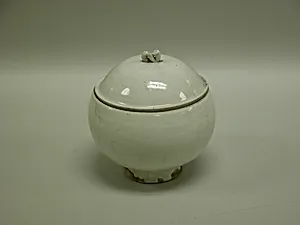
Covered bowl
Unknown Artist
12th–13th century
Medium
Stoneware with white slip (Cizhou ware)
Dimensions
H. with cover 4 1/2 in. (11.4 cm); Diam. 4 3/8 in. (11.1 cm)
Classification
Ceramics
Culture & Period
China · Jin dynasty (1115–1234)
Department
Asian Art
Museum
Metropolitan Museum of Art, New York, NY
Credit
Rogers Fund, 1918
Accession Number
18.58a, b
Rights
Public Domain
Art Historical Context
This delicate covered bowl, crafted in the 12th–13th century during China's Jin dynasty (11151234), exemplifies the artistry of Cizhou ware from northern kilns in Hebei. Made of durable stoneware coated with a white slip—a liquid clay suspension that created a smooth, contrasting surface for decoration—this small vessel (just 4½ inches tall with its lid) was both functional and elegant. The slip technique allowed artisans to incise, paint, or sgraffito designs, producing everyday objects with a sophisticated aesthetic typically reserved for finer wares. Cizhou ware flourished amid the Jin dynasty's cultural vibrancy, a period when Jurchen rulers fostered ceramic innovation despite political upheaval from Mongol threats. These kilns democratized beauty, making high-quality stoneware accessible beyond imperial courts for tea ceremonies, food storage, or medicinal use. The bowl's compact form and secure lid highlight practical ingenuity, reflecting Song-Jin era values of harmony between utility and artistry. Acquired through the Rogers Fund in 1918, this piece from the Metropolitan Museum of Art's Asian Art collection invites us to appreciate the anonymous potter's mastery—proof that timeless elegance often emerged from humble workshops.