
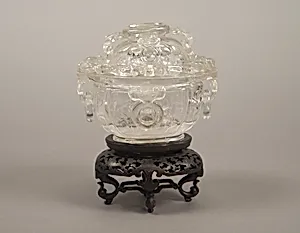
Covered bowl
Unknown Artist
18th century
Medium
Rock crystal
Dimensions
H. 4 3/4 in. (12.1 cm); W. 4 in. (10.2 cm); L. 5 3/4 in. (14.6 cm)
Classification
Hardstone
Culture
China
Department
Asian Art
Museum
Metropolitan Museum of Art, New York, NY
Credit
Alfred W. Hoyt Collection, Bequest of Rosina H. Hoppin, 1965
Accession Number
65.86.191a–c
Rights
Public Domain
Art Historical Context
This exquisite covered bowl, crafted in the 18th century during China's Qing dynasty, exemplifies the pinnacle of hardstone carving. Fashioned from rock crystal—a exceptionally clear and durable form of quartz—the bowl measures just 4 3/4 inches high, 4 inches wide, and 3/4 inches long, making it a delicate yet substantial luxury object. Its translucent medium allows light to dance through the stone, highlighting the artisan's skill in shaping both the bowl and its fitted lid without visible flaws or imperfections. In Chinese culture, rock crystal vessels like this were prized possessions of the elite, often produced in imperial workshops or by master lapidaries. Such hardstone pieces symbolized refinement, purity, and imperial prestige, frequently used for storing precious spices, incense, or as part of scholarly desk sets. The 18th century saw a flourishing of these intricate carvings, reflecting the era's opulence and technical virtuosity, where carvers employed diamond-tipped tools to polish and hollow out the unyielding quartz. Today, housed in the Metropolitan Museum of Art's Asian Art Department as part of the Alfred W. Hoyt Collection, this anonymous masterpiece invites visitors to marvel at the fusion of natural beauty and human ingenuity, a timeless testament to Qing artistry.