
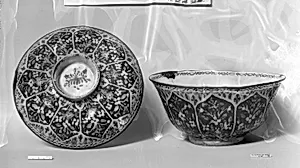
Covered bowl with floral pattern
Unknown Artist
19th century
Medium
Porcelain painted in overglaze polychrome enamels (Bencharong ware for Thai market)
Dimensions
H. 4 3/4 in. (12.1 cm); Diam. 6 7/8 in. (17.5 cm)
Classification
Ceramics
Culture & Period
China · Qing dynasty (1644–1911)
Department
Asian Art
Museum
Metropolitan Museum of Art, New York, NY
Credit
Avery Fund, 1909
Accession Number
09.70.91a, b
Rights
Public Domain
Art Historical Context
This delicate covered bowl, adorned with a vibrant floral pattern, exemplifies 19th-century Chinese porcelain craftsmanship from the Qing dynasty (1644–1911). Produced in China but tailored as Bencharong ware for the Thai market, it reflects the era's thriving export trade, where luxury ceramics bridged East Asian cultures. Standing just 4¾ inches tall and 6⅞ inches in diameter, its compact size suggests it served as elegant tableware—perhaps for sweets, spices, or teas—blending utility with opulent display. The bowl's medium, porcelain painted in overglaze polychrome enamels, is a hallmark of Bencharong style, named for the Thai term meaning "five colors." Artisans applied vivid enamels in multiple hues after the initial glazing and high-temperature firing, then refired at lower heat to fuse the colors without dulling them. This technique allowed for intricate floral motifs that burst with reds, blues, golds, and greens, capturing nature's exuberance in miniature. Housed in the Metropolitan Museum of Art's Asian Art Department (acquired via the Avery Fund in 1909), this anonymous masterpiece highlights Qing innovation in global commerce and the enduring allure of Sino-Thai artistic exchange. Visitors can appreciate how such pieces turned everyday rituals into visual feasts.