
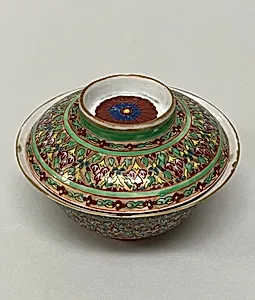
Covered bowl with floral pattern
Unknown Artist
late 19th century
Medium
Porcelain painted in overglaze polychrome enamels (Bencharong ware for Thai market)
Dimensions
H. 3 3/8 in. (8.6 cm); Diam. 5 5/8 in. (14.3 cm)
Classification
Ceramics
Culture & Period
China · Qing dynasty (1644–1911), Tongzhi period (1862–74)
Department
Asian Art
Museum
Metropolitan Museum of Art, New York, NY
Credit
Purchase by subscription, 1879
Accession Number
79.2.1362a, b
Rights
Public Domain
Art Historical Context
This delicate covered bowl, adorned with vibrant floral patterns, exemplifies the porcelain craftsmanship of China's Qing dynasty during the Tongzhi period (186274). Standing just 3⅜ inches tall and 5⅝ inches in diameter, was produced in the late 19th century overglaze polychromeels—a technique where colorful enamels were fired onto the glazed surface after the initial high-temperature kiln firing. This method allowed for intricate, vivid designs that wouldn't survive the porcelain's primary firing, resulting in the bowl's bright, durable decoration. Known as Bencharong ware, this piece was specifically made for the Thai market, reflecting robust Sino-Thai trade networks. "Bencharong" derives from the Thai word for "five colors," highlighting the signature palette of reds, blues, greens, yellows, and blacks used in floral motifs symbolizing prosperity and beauty. Such bowls were prized in Thai elite households for serving sweets or spices, blending Chinese technical mastery with Southeast Asian tastes. Acquired by subscription in 1879, this bowl entered the Metropolitan Museum of Art's Asian Art collection early on, offering visitors a tangible link to 19th-century global exchange and the enduring allure of Qing ceramics.