
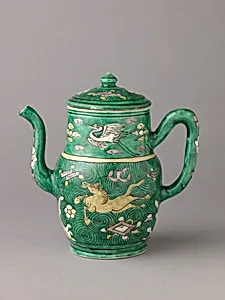
Covered ewer
ca. 1644–83
Medium
Porcelain painted in enamels on the biscuit.
Dimensions
Height with lid: 17.1 cm.
Classification
Ceramics
Culture
Chinese
Department
Robert Lehman Collection
Museum
Metropolitan Museum of Art, New York, NY
Credit
Robert Lehman Collection, 1975
Accession Number
1975.1.1693
Rights
Public Domain
Tags
Art Historical Context
This exquisite covered ewer, crafted in China around 1644–83 during the early Qing dynasty, exemplifies the pinnacle of imperial porcelain artistry. Standing just 17.1 cm tall with its lid, it is made biscuit porcelain—unglazed fired clay—painted with vibrant enamels. This technique, where colorful enamels applied over the matte biscuit body and low-fired, creates a soft, tactile surface that contrasts beautifully with the glossy overglaze wares of the era, highlighting the Dehua kilns' innovative mastery. The ewer's decorations feature lively horses and graceful cranes, auspicious motifs in Chinese culture. Horses symbolize speed, success and imperial power, while cranes represent longevity and good fortune—perfect emblems for a vessel likely used in elite rituals or as a scholarly object. Produced amid the Kangxi emperor's reign (beginning 1662), such pieces reflect the dynasty's flourishing ceramic trade, blending technical precision with symbolic depth. Now in the Robert Lehman Collection at The Metropolitan Museum of Art (acquired 1975), this ewer offers a window into Qing opulence, inviting visitors to appreciate its delicate elegance and cultural resonance.
About the Artist
Chinese
The artist known simply as "Chinese" in museum records represents the vast tradition of anonymous or unattributed masters in Chinese art history, with 99 works preserved in our collection. These pieces exemplify the enduring legacy of guó huà, or traditional Chinese painting, one of the world's oldest continuous artistic practices. Early life is not well documented, as is common for many practitio...