
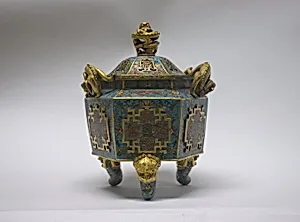
Covered Incense Burner
Unknown Artist
Medium
Cloisonné enamel on copper
Dimensions
H. 10 1/2 in. (26.7 cm); W. 8 1/4 in. (21 cm)
Classification
Cloisonné
Culture & Period
China · Qing dynasty (1644–1911), Kangxi period (1662–1722)
Department
Asian Art
Museum
Metropolitan Museum of Art, New York, NY
Credit
Gift of Edward G. Kennedy, 1929
Accession Number
29.110.50a, b
Rights
Public Domain
Tags
Art Historical Context
This elegant covered incense burner, crafted in cloisonné enamel on copper China's Qing dynasty Kangxi period (16621722), exemplifies the court's fascination with luxurious decorative arts. Standing about 10½ inches tall and 8¼ inches wide, it was designed for burning incense in temples, palaces, or scholarly homes, where aromatic smoke symbolized purity and spiritual harmony. Gifted to the Metropolitan Museum of Art in 1929 by Edward G Kennedy, it now graces the Asian Art department, showcasing the era's technical mastery and opulent tastes. Cloisonné, the burner's medium, involves soldering thin metal wires—often gold or silver—onto a copper body to form intricate cells, which are filled with colorful enamel pastes and repeatedly fired in kilns for a vibrant, gem-like finish. Popularized in China during the Ming dynasty and refined under Kangxi emperor's patronage, this technique blended European and Japanese influences with native motifs, producing durable, jewel-toned vessels prized by elites. Dragon motifs, a hallmark tag for this piece, evoke imperial power and cosmic forces in Chinese culture, their sinuous forms likely winding across the surface in brilliant blues, reds, and golds. Such burners not only served practical rituals but also embodied the Kangxi reign's artistic zenith, bridging utility and splendor.