
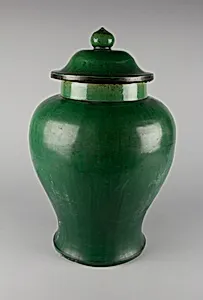
Covered jar
Unknown Artist
16th century
Medium
Stoneware with green and brown glaze (Shanxi ware)
Dimensions
H. 18 1/4 in. (46.4 cm); Diam. 12 1/4 in. (31.1 cm)
Classification
Ceramics
Culture & Period
China · Ming dynasty (1368–1644)
Department
Asian Art
Museum
Metropolitan Museum of Art, New York, NY
Credit
H. O. Havemeyer Collection, Bequest of Mrs. H. O. Havemeyer, 1929
Accession Number
29.100.268a, b
Rights
Public Domain
Art Historical Context
This elegant covered jar, crafted in the 16th century during China's Ming dynasty (1368–1644), exemplifies the refined stoneware production of Shanxi province. Standing at 18¼ inches tall with a 12¼-inch diameter, its generous form was ideal for storing precious commodities like tea, spices, or grains, reflecting the era's emphasis on functional beauty in everyday ceramics. The green and brown glaze—hallmarks of Shanxi ware—creates a subtle, earthy harmony, with the evoking celadon traditions and the brown suggesting iron-rich temmoku influences, applied over durable stoneware for both practicality and aesthetic appeal. Shanxi kilns, though less renowned than imperial Jingdezhen porcelain centers, thrived in the Ming period by innovating regional styles for domestic and export markets. This jar's robust body and fitted lid showcase masterful potter's wheel techniques and glaze firing, where subtle drips and pooling add natural texture. As part of the H. O. Havemeyer Collection at The Metropolitan Museum of Art, it highlights early 20th-century American passion for Asian art, bridging Ming craftsmanship with global appreciation. Such pieces remind us of the Ming dynasty's ceramic golden age, where even provincial wares embodied imperial elegance and cultural prosperity.