
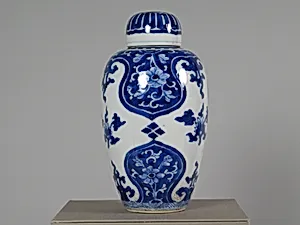
Covered Jar
Unknown Artist
late 17th–early 18th century
Medium
Porcelain painted in underglaze blue
Dimensions
H. 6 1/2 in. (16.5 cm)
Classification
Ceramics
Culture & Period
China · Qing dynasty (1644–1911), Kangxi period (1662–1722)
Department
Asian Art
Museum
Metropolitan Museum of Art, New York, NY
Credit
Purchase by subscription, 1879
Accession Number
79.2.294a, b
Rights
Public Domain
Tags
Art Historical Context
This delicate covered jar, crafted in China during the Kangxi period (1662–1722) of the Qing dynasty exemplifies the era's mastery of porcelain artistry. Standing just 6½ inches tall, it served both practical and decorative purposes—likely for storing spices, tea, or cosmetics—while showcasing the imperial kilns' technical prowess. Produced in the late 17th to early 18th century such jars were highly prized export wares, traveling along trade routes to Europe and beyond, where they inspired local ceramics. The jar's medium, porcelain painted in underglaze blue, highlights a revered technique refined at Jingdezhen, China's porcelain capital. Cobalt pigment was applied beneath a transparent glaze before high-temperature firing, yielding vibrant blues that wouldn't fade. Floral motifs, suggested by its tags, adorn these pieces with elegant, naturalistic designs—peonies or lotus symbolizing prosperity and purity—reviving Ming dynasty styles under Kangxi's patronage, a golden age for blue-and-white porcelain. Acquired by the Metropolitan Museum of Art through public subscription in 1879, this anonymous artist's work invites us to appreciate Qing innovation: objects of everyday elegance that bridged East and West, enduring as testaments to cultural exchange.