
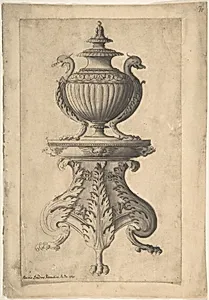
Covered Vase on a Three-Footed Pedestal
1510–84
Medium
Pen and black ink, brush and gray wash
Dimensions
10 3/8 x 6 5/16 in. (26.3 x 16 cm.)
Classification
Drawings
Department
Drawings and Prints
Museum
Metropolitan Museum of Art, New York, NY
Credit
Harris Brisbane Dick Fund, 1929
Accession Number
29.58.31.75
Rights
Public Domain
Tags
Art Historical Context
Jacques Androuet du Cerceau (1510–1584), a leading French architect and engraver of the Renaissance, crafted this exquisite drawing as part of his renowned designs for ornamental objects. Titled *Covered Vase on a Three-Footed Pedestal it exemplifies the intricate decorative motifs popular in 16th-century France, architectural precision with fantastical elements. Housed in the Metropolitan Museum Art's Drawings and Prints, this work (acquired via the Harris Brisbane Dick Fund in1929) captures du Cerceau's fascination with elegant vessels elevated on sturdy, tripod-like bases. Rendered in pen and black ink with brush and gray wash on a modest sheet measuring 10 3/8 x 6 5/16 inches, the drawing showcases du Cerceau's masterful technique. Fine lines delineate the vase's covered form, while subtle gray washes add depth and shadow, evoking the gleam of polished metal or ceramics. Tags highlighting birds, leaves, and vases suggest a richly adorned surface, alive with natural motifs—hallmarks of Renaissance grotesque style inspired by ancient Roman decorations revived at Fontainebleau. This piece holds historical significance as a design study, likely intended for silversmiths, potters, or architects. Du Cerceau's publications disseminated such patterns across Europe, influencing decorative arts from furniture to facades and bridging the gap between drawing and craft in the opulent world of Renaissance patronage.
About the Artist
Jacques Androuet Du Cerceau · 1510–1585
Jacques I Androuet du Cerceau (c. 1510–1584), born in Paris to a wine merchant, emerged as a pivotal figure in introducing Renaissance architecture to France through his innovative designs and engravings. Trained as an architect, decorator, and engraver, he established a printshop in Orléans around 1549, where he began producing influential suites of engravings, starting with triumphal arches. His...