
Coverlet
Medium
Cotton and wool; Doublecloth, woven on a hand-loom with a Jacquard attachment
Dimensions
98 3/8 x 75 in. (249.9 x 190.5 cm)
Classification
Coverlet
Culture
American
Department
The American Wing
Museum
Metropolitan Museum of Art, New York, NY
Credit
Mrs. Roger F. Brunschwig Fund, 1988
Accession Number
1988.127
Rights
Public Domain
Tags
Art Historical Context
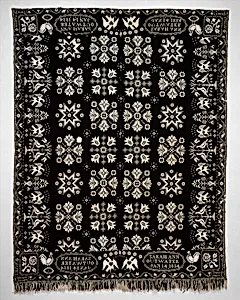
This exquisite coverlet, woven by David Daniel Haring 1834, exemplifies 19th-century American artistry. Crafted from cotton wool using the doublecloth technique on a handloom equipped with a Jacquard, it measures an impressive 98 3/8 x 75 inches, perfect for a full bedspread. The Jacquard mechanism, a revolutionary innovation from the early 1800s, enabled weavers like Haring to create intricate, reversible patterns without the tedious manual selection of threads, transforming domestic production into a showcase of mechanical ingenuity. Adorned with motifs of flowers and birds—common symbols of nature and abundance in folk art—the coverlet's bold designs reflect the vibrant aesthetic of rural American life during the Jacksonian era. Doublecloth construction, where two layers are woven simultaneously, ensured durability and warmth, making it both a functional household item and a status symbol for skilled artisans. Housed in The Metropolitan Museum of Art's American Wing, this piece highlights the cultural importance of handwoven coverlets in early American homes, blending European weaving traditions with emerging industrial techniques. A testament to Haring's craftsmanship, it invites visitors to appreciate the hidden artistry in everyday objects.