
Coverlet
1840/45
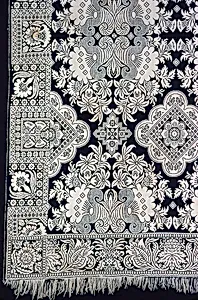
Medium
Cotton and wool, plain weave double cloth; woven on loom with Jacquard attachment; two loom widths joined
Dimensions
228.5 × 193.2 cm (90 × 76 in.); Repeat: H.: 78.7 cm (31 in.)
Classification
textile
Department
Textiles
Museum
Art Institute of Chicago
Accession Number
44783
Rights
Public Domain
Art Historical Context
This striking coverlet, woven by Hugh Gilchrist around 1840–45, exemplifies the remarkable advancements in textile production during the early Industrial Revolution. Measuring over seven feet in length, the piece is crafted from cotton and wool in a plain-weave double cloth structure. Its intricate design was made possible by a Jacquard attachment on the loom—an innovative mechanism that used punched cards to control individual threads, enabling complex patterns that would have been extremely time-consuming to produce by hand. The coverlet’s construction from two separate loom widths joined together highlights both the technical limitations and creative solutions of mid-nineteenth-century weaving. Double-cloth technique creates a reversible fabric with distinct patterns on each side, offering both visual interest and practical warmth. Such textiles were prized in American and European households as both functional bed coverings and displays of craftsmanship. Gilchrist’s work reflects the broader cultural shift toward mechanized production while preserving the decorative traditions of domestic textiles. Today, it stands as a testament to how new technology expanded artistic possibilities in everyday objects, transforming humble materials into enduring works of woven art now preserved at the Art Institute of Chicago.