
Cow Bell
1935/1942
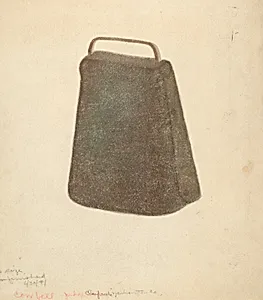
Medium
watercolor and graphite on paper
Dimensions
overall: 38.8 x 30.9 cm (15 1/4 x 12 3/16 in.)
Classification
Index of American Design
Department
CG-W
Museum
National Gallery of Art, Washington, D.C.
Credit
Index of American Design
Accession Number
1943.8.8812
Rights
Public Domain
Art Historical Context
**Cow Bell** (1935/1942) is a captivating watercolor and graphite drawing on paper, measuring 38.8 x 30.9 cm, created by an American 20th-century artist part of the *Index of American Design*. project, housed in the National of Art's CG-W, meticulously documented everyday American folk objects, transforming humble items like this cow bell—a practical tool used by farmers to track livestock—into celebrated works of art. The piece exemplifies the era's focus on national identity through design, rendering the bell's weathered metal, rivets, and leather strap with remarkable precision and vibrancy. Produced during the Great Depression under the Works Progress Administration (WPA) Federal Art Project, the *Index* employed artists from 1935 to 1942 to create over 15,000 renderings of regional crafts, furniture, and tools. *Cow Bell* highlights the cultural importance of agrarian life in America, preserving the ingenuity of anonymous makers whose handcrafted items embodied utilitarian beauty and regional traditions. The mixed-media technique—graphite for sharp outlines and fine details, layered with watercolor for subtle tones and metallic sheen—brings the object's texture to life, inviting viewers to appreciate the artistry in the ordinary. A testament to American heritage, it reminds us how design weaves into our daily stories.
About the Artist
American 20th Century · 1900–1999
"American 20th Century" is the designation used by major institutions such as the National Gallery of Art (NGA) for anonymous and unidentified artists active in the United States during the twentieth century. The artist's personal identity, early life, and training remain undocumented, reflecting the challenges of attribution for unattributed works from this era. No specific teachers, art schools,...