
Cowroid Inscribed with a Nefer Hieroglyph
Unknown Artist
ca. 1492–1473 B.C.
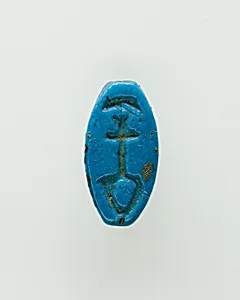
Medium
Faience
Dimensions
L. 1.4 cm (9/16 in.), W. 0.8 cm (5/16 in.); H. 0.4 cm (3/16 in.)
Classification
Cowroid, nefer
Period
New Kingdom
Department
Egyptian Art
Museum
Metropolitan Museum of Art, New York, NY
Credit
Rogers Fund, 1936
Accession Number
36.3.23
Rights
Public Domain
Tags
Art Historical Context
This delicate *Cowroid Inscribed with afer Hieroglyph*, crafted around 1492–1473 B.C. during the early New Kingdom's Dynasty 18, exemplifies the exquisite miniaturization of Egyptian art. Measuring just 1.4 cm long, 0.8 cm wide, and 0.4 cm high, this faience amulet—made from a glazed, quartz-based ceramic prized for its vibrant blue-green hues and glossy finish—likely served as a protective talisman, seal, or bead in jewelry. Faience's durability and luminous quality made it ideal for everyday sacred objects, mimicking more precious stones like lapis lazuli while being accessible to a wide range of people. The object's cowrie shell-inspired shape, known as a "cowroid," draws from natural forms symbolizing fertility and protection in ancient Egyptian culture. Its inscription features the *nefer* hieroglyph—a stylized heart and windpipe sign meaning "beautiful," "good," or "perfect"—evoking divine harmony and well-being. Produced in the innovative workshops of Thebes or Memphis, such items reflect the era's religious devotion and mastery of micro-carving techniques. Acquired through the Rogers Fund in 1936, this tiny treasure from the Metropolitan Museum of Art's Egyptian collection offers a window into the New Kingdom's blend of artistry and spirituality, reminding us how even the smallest artifacts carried profound cultural weight.