
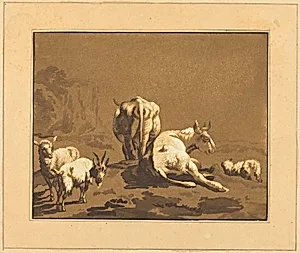
Cows
Medium
color aquatint and etching
Dimensions
mount: 48.6 × 33.4 cm (19 1/8 × 13 1/8 in.) sheet (trimmed within platemark): 16.2 × 20.4 cm (6 3/8 × 8 1/16 in.)
Classification
Portfolio
Department
CG-E
Museum
National Gallery of Art, Washington, D.C.
Credit
Rosenwald Collection
Accession Number
1948.11.273
Rights
Public Domain
Art Historical Context
Welcome to the National Gallery of, where Johann Gottlieb Prestel's *ows* (1782–1785) invites you into the serene world of 18th-century life. Created after Austrian engraver Joseph Wagner, this intimate print captures grazing cows in a tranquil landscape, reflecting the era's fascination with nature and rural simplicity amid the Enlightenment's embrace of the everyday. Prestel, a pioneering German printmaker, faithfully reinterprets Wagner's composition on a modest sheet trimmed to just 16.2 × 20.4 cm, mounted elegantly at 48.6 × 33.4 cm. What makes *Cows* stand out is its innovative use of color aquatint combined with etching—a breakthrough technique in the late 1700s. Aquatint, using powdered rosin to create velvety tones, mimics watercolor's fluidity, while etching provides crisp lines for the animals' forms. Prestel was among the first to master color aquatint, layering inks to achieve rich, painterly effects that brought prints closer to paintings. This rarity elevated printmaking from mere reproduction to an art form in its own right. Part of the esteemed Rosenwald Collection in the museum's prints portfolio, *Cows* showcases how such techniques democratized art, making vivid scenes accessible beyond oil canvases. Pause here to appreciate its subtle hues and lifelike bovines—a charming window into pre-Romantic harmony with the natural world.