
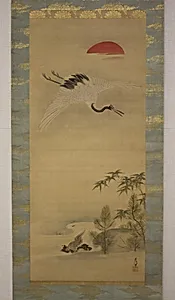
Crane, Tortoise, Pine, and Bamboo under a Rising Sun
17th–18th century
Medium
Hanging scroll; ink and color on silk
Dimensions
Image: 40 1/2 × 17 3/4 in. (102.9 × 45.1 cm) Overall with mounting: 74 × 23 1/4 in. (188 × 59.1 cm) Overall with knobs: 74 × 25 1/8 in. (188 × 63.8 cm)
Classification
Paintings
Culture & Period
Japan · Edo period (1615–1868)
Department
Asian Art
Museum
Metropolitan Museum of Art, New York, NY
Credit
The Howard Mansfield Collection, Purchase, Rogers Fund, 1936
Accession Number
36.100.6
Rights
Public Domain
Tags
Art Historical Context
In the serene elegance of Edo-period Japan (1615–1868), Kano Chikanobu's *Crane, Tortoise,, and Bamboo under a Sun* captures timeless symbols of longevity and prosperity. As a master of the Kano school—one of Japan's most prestigious painting lineages serving the shogunate—this 17th–18th-century hanging scroll the school's bold, decorative style. Rendered in ink and vibrant colors on luxurious silk, it measures an impressive 40½ × 17¾ inches, designed to unfurl dramatically for special occasions in elite homes or temples. Central to the composition are auspicious motifs deeply rooted in Chinese and Japanese lore: the crane and tortoise embody eternal life and steadfastness, while pine and bamboo represent resilience through seasons. Bathed in the glow of a rising sun—evoking Japan's imperial emblem—these elements form a harmonious wish for good fortune. The hanging scroll format, with its elaborate mounting, highlights the artwork's role in rituals, transforming walls into portals of auspicious energy. Displayed in the Metropolitan Museum of Art's Asian Art collection (acquired via The Howard Mansfield Collection in 1936), this piece invites reflection on Edo Japan's cultural flourishing, where art blended Zen simplicity with opulent symbolism to inspire harmony and endurance.
About the Artist
Kano Chikanobu (Japanese) · 1660 –1728
Japanese, 1660–1728