
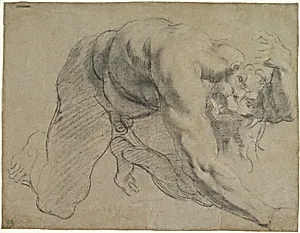
Crawling Male Figure (Study for Cacus)
Medium
Charcoal or soft black chalk, highlighted with traces of white chalk, on blue-gray paper faded light brown
Dimensions
sheet: 15 3/16 x 19 5/8 in. (38.5 x 49.9 cm)
Classification
Drawings
Department
Drawings and Prints
Museum
Metropolitan Museum of Art, New York, NY
Credit
Bequest of Walter C. Baker, 1971
Accession Number
1972.118.244
Rights
Public Domain
Tags
Art Historical Context
In the late 16th century,ibale Carracci, leading figure of the Bolognese school, bridged Renaissance naturalism and the emerging Baroque style with his dynamic figure studies. Created around 1593, *Crawling Male Figure ( for Cacus)* captures a muscular male form in a tense, crawling pose, likely preparatory for a depiction of Cacus—the fire-breathing giant from classical mythology slain by Hercules. This sheet exemplifies Carracci's innovative approach, emphasizing anatomical precision and expressive movement to convey raw power and vulnerability. Executed in charcoal or soft black chalk with subtle white highlights on blue-gray paper (now faded to light brown), the drawing masterfully exploits the toned ground to model form through light and shadow. This "three-chalk" technique, popular among Italian draftsmen, allowed Carracci to achieve remarkable three-dimensionality and vitality in preliminary sketches, bridging studio preparation and grand frescoes or paintings. Housed in the Metropolitan Museum of Art's Drawings and Prints department, this work highlights Carracci's role in revitalizing art through life-like studies, influencing generations of artists. Its generous scale—nearly 15 by 19 inches—invites viewers to appreciate the tactile energy of the chalk, a testament to the era's fascination with the human body as heroic narrative.
About the Artist
Annibale Carracci · 1560–1609
Annibale was considered one of the greatest Italian painters of his age. His style is marked by naturalism combined with the formal language of Classicism in a grand and monumental style. Annibale was also instrumental in evolving the ideal, classical landscape and is generally credited with the invention of caricature. Italian painter. Comment on works: Mythology.