
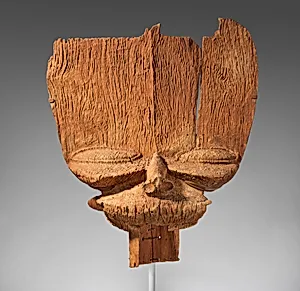
Crest (Tsesah)
Unknown Artist
18th century
Medium
Wood
Dimensions
H. 37 × W. 32 1/2 × D. 11 1/2 in. (94 × 82.6 × 29.2 cm)
Classification
Wood-Sculpture
Culture
Bamileke peoples
Department
Arts of Africa, Oceania, and the Americas
Museum
Metropolitan Museum of Art, New York, NY
Credit
Purchase, Acquisitions and Rogers Funds, and Anonymous, James J. Ross, and Marian Malcolm Gifts, 2017
Accession Number
2017.35
Rights
Public Domain
Art Historical Context
This striking wooden crest, known as a Tsesah, was created by an unknown artist among the Bamileke peoples in the 18th century. Measuring over three feet tall, the sculpture’s bold, architectural form was designed to be worn or displayed during important communal ceremonies. Its surface features expressive faces that likely served symbolic roles, connecting participants to ancestral spirits and reinforcing social hierarchies within Bamileke society. As a ceremonial object carved from wood, the Tsesah highlights the Bamileke tradition of transforming natural materials into powerful visual statements. The medium’s durability allowed such works to be passed down through generations, preserving both artistic skill and cultural memory. Acquired by the Metropolitan Museum of Art in 2017, this piece offers visitors a window into the rich artistic heritage of the Cameroon Grassfields region. The crest’s dramatic scale and facial motifs invite contemplation of how art functions in ritual life, blending beauty with profound social meaning.