
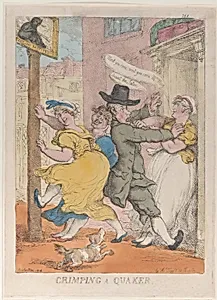
Crimping a Quaker
March 1, 1814
Medium
Hand-colored etching
Dimensions
Sheet: 13 3/4 × 9 15/16 in. (35 × 25.3 cm)
Classification
Prints
Department
Drawings and Prints
Museum
Metropolitan Museum of Art, New York, NY
Credit
The Elisha Whittelsey Collection, The Elisha Whittelsey Fund, 1959
Accession Number
59.533.1559
Rights
Public Domain
Tags
Art Historical Context
Step into the witty world of early 19th-century British satire with *Crimping a Quaker*, a hand-colored etching by master caricaturist Thomas Rowlandson, published by Thomas Tegg on March 1, 1814. Measuring 13 3/4 × 9 15/16 inches, this lively print from the Metropolitan Museum of Art's Elisha Whittelsey Collection exemplifies Rowlandson's signature style: exaggerated figures, dynamic compositions, and vibrant hand-coloring that brings his social commentary to life. As a key figure in the golden age of caricature alongside artists like James Gillray, Rowlandson used etching—a precise yet flexible printmaking technique—to produce affordable, widely circulated satires critiquing British society. The title pokes fun at "crimping," the notorious practice of tricking or forcibly recruiting men into the Royal Navy during the Napoleonic Wars (1803–1815), when Britain desperately needed sailors to combat Napoleon. Here, Rowlandson targets a Quaker—a pacifist religious group known for plain dress and anti-war principles—amid a chaotic scene involving men, women, and even dogs. The humor lies in the absurdity: a peace-loving Quaker ensnared by unscrupulous recruiters, highlighting the era's tensions between military demands and personal freedoms. This print's cultural punch endures as a snapshot of wartime Britain, blending sharp social critique with Rowlandson's playful grotesquerie. It invites us to laugh while reflecting on the human cost of empire.
About the Artist
Thomas Rowlandson|Thomas Tegg · 1756–1827
Thomas Rowlandson (1757–1827) was an English artist and caricaturist whose satirical watercolors and prints captured the social life of Georgian Britain with unparalleled wit and technical mastery. Alongside James Gillray, he is recognized as one of the greatest British graphic artists, and his distinctive flowing line and keen observations have made his work integral to understanding late 18th an...