
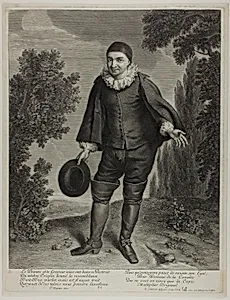
Crispin
1682
Medium
Engraving on ivory laid paper
Dimensions
Plate: 48.2 × 37 cm (19 × 14 5/8 in.); Sheet: 49.7 × 38.2 cm (19 5/8 × 15 1/16 in.)
Classification
engraving
Department
Prints and Drawings
Museum
Art Institute of Chicago
Accession Number
143
Rights
Public Domain
About this artwork
Gerard Edelinck was a French engraver and print publisher of Flemish origin who worked in Paris beginning in 1666. He was admitted to the Academie Royale in 1677 and became a councilor of that body and First Draftsman to the Cabinet du Roi in 1694. Although he specialized in engraved portraits, he also made prints after other artists, such as this charming portrait of N. Poisson as Crispin, the unscrupulous comic valet of the Comedie-Francaise, based on the portrait by Theodorus Netscher (active...
Art Historical Context
Gérard Edelinck’s “Crispin,” dated 1682, stands as a fine example of late Baroque printmaking. Born in Antwerp and active at the French court, Edelinck specialized in engravings that translated paintings into meticulously detailed prints. His works helped disseminate images of notable figures and compositions throughout Europe at a time when original paintings remained largely inaccessible to most viewers. The engraving technique itself is central to the piece’s significance. Executed on ivory laid paper, the medium allowed for crisp lines and subtle tonal gradations that could be reproduced in multiple impressions. At roughly 48 by 37 centimeters, the plate size indicates an ambitious composition meant to command attention while remaining portable enough for collectors and scholars to study or display. Housed in the Art Institute of Chicago’s Prints and Drawings department, this work underscores the cultural role of reproductive engraving in the seventeenth century. Such prints preserved artistic achievements, fostered artistic dialogue across borders, and elevated the status of the engraver as both craftsman and interpreter of great art.