
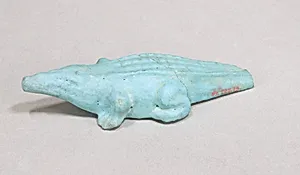
Crocodile figure
Unknown Artist
ca. 1850–1700 B.C.
Medium
Egyptian blue
Dimensions
L. 8.6 × W. 3.7 × H. 1.7 cm (3 3/8 × 1 7/16 × 11/16 in.)
Classification
Figure, Crocodile
Period
Late Middle Kingdom
Department
Egyptian Art
Museum
Metropolitan Museum of Art, New York, NY
Credit
Rogers Fund, 1907
Accession Number
07.227.19
Rights
Public Domain
Tags
Art Historical Context
This exquisite crocodile figure, crafted around 1850–1700 B.C. during Egypt's Late Middle Kingdom (asty 13), captures awe-inspiring power of the Nile's most fearsome inhabitant. Measuring just 8.6 cm long, this petite sculpture is made of Egyptian blue—a groundbreaking synthetic pigment invented by ancient Egyptians around 2500 B.C. Composed of copper compounds, silica, and lime, it produces a vibrant turquoise hue that has endured for millennia, symbolizing the sky and divine protection. In ancient Egyptian culture, crocodiles embodied both danger and divinity, often linked to Sobek, the god of the Nile's fertile waters, pharaonic strength, and renewal. Small figures like this were likely amulets or votive offerings, worn for protection or placed in temples to invoke the creature's might. The Late Middle Kingdom marked a period of political fragmentation yet artistic revival, with such faience-like objects showcasing skilled molding and glazing techniques that brought naturalistic details to life. Today, housed in the Metropolitan Museum of Art's Egyptian Art department (acquired via the Rogers Fund in 1907), this figure invites us to marvel at how ancient artisans transformed a river predator into a timeless emblem of survival and sacred power.