
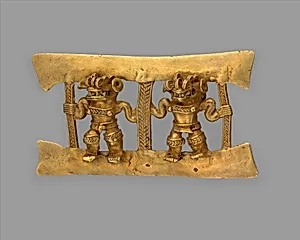
Crocodile-Head Figure Pendant
Unknown Artist
11th–16th century
Medium
Gold (cast)
Dimensions
H. 2 7/8 x W. 5 1/8 x D. 7/8 in. (7.3 x 13 x 2.2 cm)
Classification
Metal-Ornaments
Culture
Veraguas
Department
Arts of Africa, Oceania, and the Americas
Museum
Metropolitan Museum of Art, New York, NY
Credit
The Michael C. Rockefeller Memorial Collection, Bequest of Nelson A. Rockefeller, 1979
Accession Number
1979.206.885
Rights
Public Domain
Tags
Art Historical Context
Behold the *Crocodile-Head Pendant*, a masterful cast-gold ornament from the Veraguas of pre-Columbian Panama, dating to the 11th–16th centuries. Measuring just 2⅞ × 5⅛ × ⅞ inches, this petite yet powerful piece captures the fierce visage of a crocodile in exquisite detail—its jaws agape, eyes alert, and textured scales rendered with remarkable precision. Crafted using the lost-wax casting technique, sophisticated method that allowed Veraguas goldsmiths to create intricate, hollow forms from precious metal, it exemplifies the region's unparalleled metalworking prowess. In Veraguas society, gold ornaments like this pendant were more than jewelry; they were emblems of elite status, likely worn suspended from necklaces during rituals or daily life. Crocodiles, potent symbols in Isthmian cosmologies, may have evoked the watery realms of creation and power, bridging the earthly and spiritual worlds. This artifact highlights the vibrant trade networks of ancient Panama, where gold from local rivers fueled artistic innovation. Today, it graces the Metropolitan Museum of Art's Arts of Africa, Oceania, and the Americas department, part of The Michael C. Rockefeller Memorial Collection. A window into a lost world, it invites us to marvel at the ingenuity of Veraguas artisans whose legacy endures in gleaming gold.