
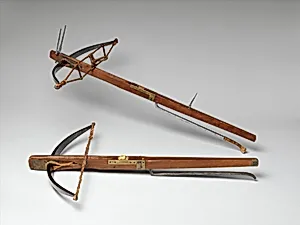
Crossbow with Spanning Lever
Unknown Artist
crossbow, ca. 1540–60; spanning lever, ca. 1525–75
Medium
Steel, wood (holly oak), staghorn, copper alloy, hemp, leather
Dimensions
crossbow L. 32 5/8 in. (82.9 cm); W. 21 1/2 in. (54.6 cm); Wt. 6 lb. (2,726 g). spanning lever L., extended 18 3/8 in. (46.6 cm); W. 2 5/8 in. (6.7 cm); Wt. 1 lb. 3 oz. (548 g)
Classification
Archery Equipment-Crossbows
Culture
Spanish, possibly Valencia or Toledo; lever possibly Madrid
Department
Arms and Armor
Museum
Metropolitan Museum of Art, New York, NY
Credit
Gift of Archer M. Huntington, 1927
Accession Number
27.160.19a, b
Rights
Public Domain
Art Historical Context
This exquisite Crossbow with Spanning Lever, dating around 1540–60 with its lever from circa 1525–75, hails from Spain—likely Valencia or Toledo for the crossbow, and Madrid for the lever.ed during the Renaissance, when Spain's arms centers like Toledo were renowned for producing high-quality weaponry, this piece reflects the era's blend of military innovation and fine craftsmanship. Crossbows were vital in warfare and hunting, prized for their power and accuracy over long distances, especially after the widespread adoption of steel prods that required mechanical aids like the spanning lever to cock the string. Made from steel, holly oak wood, staghorn, copper alloy, hemp, and leather, the crossbow measures 32⅝ inches long and weighs about 6 pounds, while the extended lever is 18⅜ inches. These materials highlight skilled metalworking and woodworking techniques: the steel prod delivers lethal force, the ergonomic wood stock ensures balance, and decorative elements like staghorn add both grip and subtle elegance. The lever's ingenious design made reloading faster and less strenuous, a practical advancement for soldiers. A gift to the Metropolitan Museum of Art from Archer M. Huntington in 1927, this artifact offers a window into 16th-century Spanish martial culture, where beauty met battlefield utility in Toledo's legendary forges.