
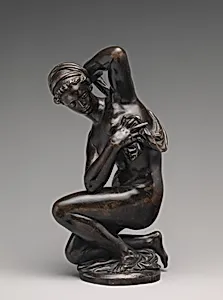
Crouching Venus
17th century
Medium
Bronze
Dimensions
Overall (confirmed): 9 7/8 × 4 1/4 × 5 3/8 in. (25.1 × 10.8 × 13.7 cm)
Classification
Sculpture-Bronze
Culture
Italian, Florence
Department
European Sculpture and Decorative Arts
Museum
Metropolitan Museum of Art, New York, NY
Credit
Gift of Ogden Mills, 1924
Accession Number
24.212.15
Rights
Public Domain
Tags
Art Historical Context
Nestled in the Metropolitan Museum of Art's European Sculpture and Decorative collection, this exquisite *Crouching Venus* is a 17th-century bronze sculpture to the renowned Florentine artist Giambologna (15291608). Standing just under 10 inches tall, the figure captures the goddess Venus in a graceful, modest crouch, her form twisting dynamically as she shields her body with delicate hands—a pose echoing ancient Hellenistic prototypes like the Crouching Aphrodite. Gifted to the Met in 1924 by Ogden Mills, this small-scale bronze exemplifies the Renaissance revival of classical antiquity in Italian art. Giambologna, a master of Mannerism, was celebrated for his innovative bronze casting techniques, often employing the lost-wax method to achieve intricate details and a rich, patinated surface. Produced in Florence, the epicenter of Medici patronage, such tabletop sculptures were prized by collectors for their elegance and erotic allure, blending mythological grace with virtuoso craftsmanship. The 17th-century date suggests a workshop casting from his models, perpetuating his legacy into the Baroque era. This *Crouching Venus* highlights the enduring cultural fascination with the female nude in Western art, symbolizing beauty, vulnerability, and divine femininity. Its compact size made it ideal for private cabinets of curiosities, inviting intimate contemplation of timeless ideals. A true gem for visitors, it bridges antiquity and the Renaissance with poised perfection.
About the Artist
Giambologna · 1529–1608
Born and trained in Flanders (Douai, his birthplace, is now in France but was once in Flanders), Giambologna traveled to Italy in 1550 to study Classical and Renaissance sculpture. There, he became court sculptor of the Medici Dukes. He was famed for compositional sophistication, sensuous, tactile treatment of human body, and sheer technical virtuosity. He was extremely influential because the Med...