
柳に鴉図|Crow and Willow Tree
November 1887
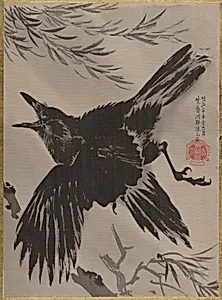
Medium
Album leaf; ink and color on silk
Dimensions
14 1/4 x 10 1/2 in. (36.2 x 26.7 cm)
Classification
Paintings
Culture & Period
Japan · Meiji period (1868–1912)
Department
Asian Art
Museum
Metropolitan Museum of Art, New York, NY
Credit
Charles Stewart Smith Collection, Gift of Mrs. Charles Stewart Smith, Charles Stewart Smith Jr., and Howard Caswell Smith, in memory of Charles Stewart Smith, 1914
Accession Number
14.76.61.36
Rights
Public Domain
Tags
Art Historical Context
Nestled in the Metropolitan Museum of Art's Asian Art collection, *Crow and Willow Tree* (に鴉図), created by Kawanabe Kysai in November 1887, captures a fleeting moment of nature's drama on a delicate album leaf of ink and color on silk Measuring just 14¼ x 10½ inches, this intimate format was prized in Japan for personal albums, allowing artists like Kyōsai—known as the "Demon Painter" for his exuberant, satirical style—to showcase bold brushwork and vivid expression in a portable scale. Kyōsai, a Meiji-era master (1868–1912), bridged traditional Japanese painting with modern whimsy during Japan's rapid Westernization. His dynamic lines and subtle color washes bring the crow to life perched among swaying willow branches, evoking haiku-like poetry in visual form. Crows, bold and intelligent in Japanese lore, often symbolize autumn or mischief, while willows represent resilience and grace—motifs rooted in ukiyo-e and literati traditions. This work, from the Charles Stewart Smith Collection, exemplifies Kyōsai's genius for infusing everyday scenes with energy and humor, offering visitors a window into late 19th-century Japan's artistic vitality amid cultural transformation.
About the Artist
Kawanabe Kyōsai 河鍋暁斎 (Japanese) · 1831 –1889
Japanese, 1831–1889