
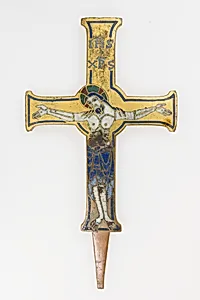
Crucifix
Unknown Artist
ca. 1150
Medium
Champlevé enamel, copper-gilt
Dimensions
Overall (with tang): 10 1/8 x 5 5/8 x 3/16 in. (25.7 x 14.3 x 0.5 cm) Overall (without tang): 7 15/16 x 5 5/8 x 3/16 in. (20.2 x 14.3 x 0.5 cm)
Classification
Enamels-Champlevé
Culture
Spanish
Department
Medieval Art
Museum
Metropolitan Museum of Art, New York, NY
Credit
Gift of George Blumenthal, 1941
Accession Number
41.100.154
Rights
Public Domain
Tags
Art Historical Context
This exquisite *Crucifix*, crafted around 1150 by an unknown Spanish artist, captures the solemn intensity of medieval Christian devotion. Depicting Christ on the cross, it measures about 8 by 5 ½ inches (without its mounting tang), making it a portable devotional object likely used in processions, private prayer, or church altars. Housed in the Metropolitan Museum of Art's Medieval Art department as a gift from Blumenthal in 1, it exemplifies the artistry of Romanesque Spain, a period when religious icons bridged the earthly and divine. The work's medium—champlevé enamel on copper-gilt—is a highlight of 12th-century metalwork innovation. In this technique, channels were carved into the copper base, filled with powdered glass enamels in vibrant colors, and fired to create a durable, gem-like surface. Gilding added a radiant glow, symbolizing heavenly light. Spanish enamellers, influenced by Byzantine and Mosan traditions, mastered this method for its vividness and longevity, producing objects that withstood time and touch. As a rare surviving example of early Spanish champlevé, this crucifix reflects the era's fervent piety amid the Reconquista, blending artistic skill with spiritual power. Visitors will appreciate its intimate scale and luminous detail, inviting quiet reflection on faith's enduring visual language.