
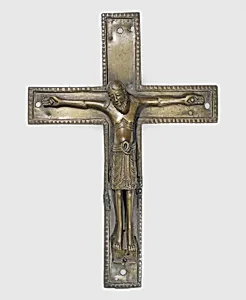
Crucifix
Unknown Artist
second half 12th century
Medium
Brass
Dimensions
Overall: 11 3/4 x 8 in. (29.8 x 20.3 cm)
Classification
Metalwork-Bronze
Culture
Rhenish
Department
The Cloisters
Museum
Metropolitan Museum of Art, New York, NY
Credit
The Cloisters Collection, 1925
Accession Number
25.120.438
Rights
Public Domain
Tags
Art Historical Context
This exquisite brass Crucifix, crafted by an unknown Rhenish artist in the second half of the 12th century, exemplifies the masterful metalwork of the Rhineland region during the Romanesque era. Measuring 11¾ x 8 inches, it depicts the crucified Christ on the cross, a powerful symbol central to medieval Christian devotion. Housed in The Cloisters at the Metropolitan Museum of Art (The Cloisters Collection, 1925), it reflects the region's thriving workshops, where artisans produced liturgical objects for monasteries and cathedrals amid a surge in pilgrimage and religious fervor. Rhenish metalworkers were renowned for their technical prowess in brass—often alloyed with other metals for durability and luster—employing techniques like casting, engraving, and chasing to create intricate surfaces that caught the light in dimly lit church interiors. This Crucifix likely served as a processional or altar piece, inviting contemplation of Christ's suffering and redemption. Its survival highlights the enduring legacy of Romanesque art, bridging Byzantine influences with emerging Gothic naturalism. Visitors to The Cloisters can appreciate how such works embodied faith's tangible beauty, underscoring the Rhineland's role as a hub of spiritual craftsmanship in medieval Europe.