
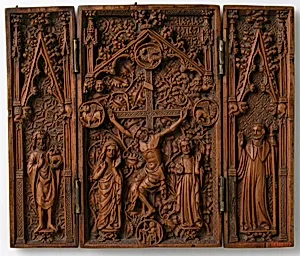
Crucifixion Triptych
Unknown Artist
15th century
Medium
Pearwood
Dimensions
Overall: 4 15/16 x 5 7/8 x 1/4in. (12.6 x 15 x 0.6cm) wings closed: 2 15/16 x 9/16in. (7.4 x 1.4cm) wing: 1 7/16 x 1/4in. (3.7 x 0.6cm)
Classification
Sculpture-Wood
Culture
German
Department
Medieval Art
Museum
Metropolitan Museum of Art, New York, NY
Credit
Gift of J. Pierpont Morgan, 1917
Accession Number
17.190.172
Rights
Public Domain
Tags
Art Historical Context
This delicate *Crucifixion Tych*, carved in pearwood by an unknown German artist in the 15 century, is a exquisite example of late medieval devotional art. Measuring just under 5 inches wide when open, this tiny sculpture unfolds like a portable prayer book, with a central panel depicting Christ's Crucion flanked by the Virgin Mary and Saint John the Baptist. wings likely feature the Evangelists, inviting intimate contemplation of salvation's core mystery. Pearwood, prized for its fine grain and resistance to splitting, allowed the sculptor to achieve remarkable detail on such a minuscule scale—evident in the expressive figures and folded dimensions when closed (under 3 inches high). Common in German households and monasteries, these triptychs served personal piety, bridging the Gothic emphasis on emotional realism with emerging Renaissance naturalism. Now housed in the Metropolitan Museum of Art's Medieval Art department, thanks to J. Pierpont Morgan's 1917 gift, it whispers of faith's quiet endurance amid the era's religious fervor and plague-shadowed lives. A testament to anonymous craftsmanship, it reminds us how art magnified the sacred in everyday hands.