
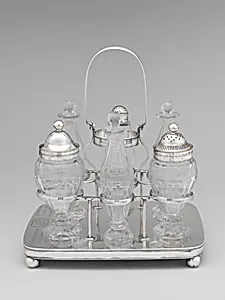
Cruet stand
ca. 1805–11
Medium
Silver
Dimensions
9 3/4 x 8 5/8 x 7 in. (24.8 x 21.9 x 17.8 cm); 20 oz. 14 dwt. (643.5 g)
Classification
Cruet stand
Culture
American
Department
The American Wing
Museum
Metropolitan Museum of Art, New York, NY
Credit
Gift of Geoffrey N. Bradfield, 1983
Accession Number
1983.441
Rights
Public Domain
Art Historical Context
This elegant cruet stand, crafted by the American silversmiths and Smith around 1805–11, exemplifies the refined silverwork of the early Federal period. Measuring about 9¾ inches tall and weighing over 20 ounces, it was designed to hold small glass bottles—or cruets—for condiments like oil, vinegar, and, gracing the sideboards of prosperous American households. Its gleaming silver construction highlights the era's emphasis on luxury domestic goods, symbols of newfound national wealth and sophistication following the Revolution. In the context of American decorative arts, such pieces reflect neoclassical influences inspired by ancient Greek and Roman designs, adapted by skilled artisans like Lewis and Smith. Silver's durability and luster made it a prized medium for tableware, often featuring chased or engraved details that showcased the maker's technical prowess—hammering, soldering, and polishing to achieve both functionality and beauty. Donated to the Metropolitan Museum of Art's American Wing in 1983, this cruet stand offers visitors a tangible glimpse into the daily elegance of elite 19th-century life, where fine silver elevated even the simplest meals into statements of taste and status.