
Cuff
Unknown Artist
7th–8th century
Medium
Camelid hair, cotton
Dimensions
W. 4 1/4 × D. 15 1/4 in. (10.8 × 38.7 cm)
Classification
Textiles-Woven
Culture
Moche-Wari
Department
Arts of Africa, Oceania, and the Americas
Museum
Metropolitan Museum of Art, New York, NY
Credit
Bequest of Jane Costello Goldberg, from the Collection of Arnold I. Goldberg, 1986
Accession Number
1987.394.708
Rights
Public Domain
Art Historical Context
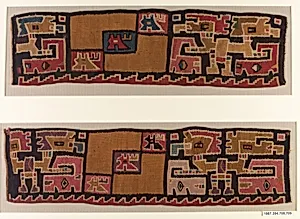
This exquisite cuff, crafted in the 7th–8th century by an unknown artist from the Moche-Wari culture of ancient Peru, offers a glimpse into the sophisticated textile traditions of the Andes. Emerging during a transitional period between the innovative Moche civilization—renowned for their vivid ceramics and intricate motifs—and the expansive Wari empire, this reflects the cultural fusion and technological prowess of pre-Columbian societies. Worn likely as part of elite garments or ceremonial attire, such cuffs symbolized status and were integral to social and ritual life. Woven from camelid hair (from alpacas or vicuñas, prized for their softness and durability) combined with cotton, the cuff measures a practical 4¼ × 15¼ inches, showcasing advanced Andean weaving techniques. Artisans employed complementary warp and weft structures, blending the insulating warmth of animal fibers with cotton's breathability—a masterful adaptation to the region's diverse climates. These textiles were not mere fabric but cultural canvases, often adorned with symbolic patterns evoking mythology, nature, or cosmology, though this cuff's precise motifs remain a testament to enduring craftsmanship. Housed in The Metropolitan Museum of Art's Department of the Arts of Africa, Oceania, and the Americas, this cuff—bequeathed by Jane Costello Goldberg in 1986—highlights the Met's commitment to preserving Andean heritage. Visitors can marvel at how such everyday yet extraordinary objects wove together art, utility, and identity in ancient Peru.