
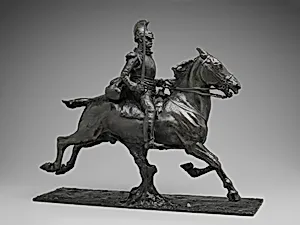
Cuirassier with Drawn Sword
Modeled c. 1875, cast after 1891
Medium
Bronze
Dimensions
49.5 × 62.5 × 21 cm (19 3/4 × 24 5/8 × 8 1/4 in.)
Classification
statuette
Department
Painting and Sculpture of Europe
Museum
Art Institute of Chicago
Accession Number
70991
Rights
Public Domain
About this artwork
Ernest Meissonier was best known for his exquisitely rendered genre scenes, which drew inspiration from the Dutch masters and were praised for their “microscopic” perfection. But he was also a serious student of military subjects, creating a series of canvases on major episodes in the life of Napoleon I. For his battle scenes, Meissonier fashioned wax sculptures of horses and military figures, such as this cavalryman (known as a cuirassier), which served as a study for the painting 1807, Friedla...
Art Historical Context
Jean Louis Ernest Meissonier, a leading French academic artist celebrated for his precise depictions of life, created this dynamic statuette around 187. Known primarily as a painter of Napoleonic scenes, Meissonier brought the same meticulous attention to detail into sculpture later in his career. The figure of a cuirassier—a heavily armored cavalryman—poised with sword drawn evokes the drama of 19th-century French warfare, reflecting the era’s fascination with heroism and national history. Cast in bronze after the artist’s death, the work exemplifies the medium’s ability to capture texture and movement in small scale. Meissonier’s realist approach shines through in the careful rendering of the soldier’s uniform, stance, and equipment, inviting viewers to appreciate both the physical weight of armor and the tension of battle. As a statuette just under 20 inches tall, it was likely intended for intimate display, allowing collectors to study its lively composition from multiple angles. Today housed in the Art Institute of Chicago’s European sculpture collection, this piece highlights Meissonier’s enduring influence on both painting and sculpture. It offers a vivid glimpse into the technical skill and historical imagination that defined academic art in the late 1800s.