
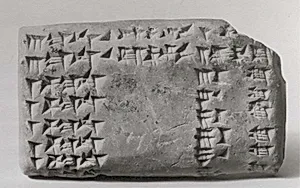
Cuneiform tablet: account of gold, Ebabbar archive
Unknown Artist
ca. 7th–6th century BCE
Medium
Clay
Dimensions
1.44 x 2.5 x .83 in. (3.66 x 6.35 x 2.1 cm)
Classification
Clay-Tablets-Inscribed
Culture & Period
Babylonian · Neo-Babylonian
Department
Ancient Near Eastern Art
Museum
Metropolitan Museum of Art, New York, NY
Credit
Purchase, 1886
Accession Number
86.11.192
Rights
Public Domain
Art Historical Context
This unassuming clay tablet, inscribed with cuneiform script, offers a window into the bustling administrative world of Neo-Babylonian Babylon around the 7th–6th centuries BCE. Measuring just 1.44 x 2.5 x 0.83 inches, it records an account of gold from thebabbar archive—the temple complex dedicated to Shamash, the sun god, in the city of Sippar. During this era, under rulers like Nebuchadnezzar II, Babylon thrived as a center of empire, trade, and religious devotion, with temples like Ebabbar managing vast wealth in precious metals for rituals, offerings, and state affairs. Cuneiform, the world's oldest writing system, was pressed into soft clay with a reed stylus to form wedge-shaped signs, then baked for durability. This practical medium made clay tablets ideal for everyday records, from royal decrees to economic ledgers, preserving thousands of such documents that reveal the precision of Babylonian bureaucracy. Far from mere accounting, this tablet highlights gold's sacred role in temple economies, underscoring the intertwining of religion, finance, and power. Acquired by the Metropolitan Museum of Art in 1886, this artifact from the Ancient Near Eastern collection reminds us how "ordinary" objects illuminate extraordinary histories—inviting us to ponder the scribes who tallied treasures amid Babylon's golden age.