
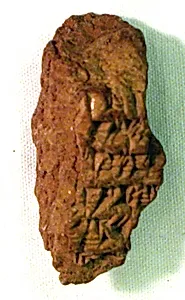
Cuneiform tablet: bilingual (?) unidentified literary fragment
Unknown Artist
ca. late 1st millennium BCE
Medium
Clay
Dimensions
1 1/4 x 1/2 x 1/2 in. (3.1 x 1.3 x 1.2 cm)
Classification
Clay-Tablets-Inscribed
Department
Ancient Near Eastern Art
Museum
Metropolitan Museum of Art, New York, NY
Credit
Purchase, 1886
Accession Number
86.11.506
Rights
Public Domain
Art Historical Context
This petite clay tablet, measuring just over an inch in length, hails from the Ancient Near East around the late 1st millennium BCE—likely the Neo-Babylonian or early Persian period. Acquired by the Metropolitan Museum of Art in 1886, it exemplifies the humble yet revolutionary medium of inscribed clay tablets, which served as the primary "books" of Mesopotamian civilization. Shaped by hand and dried or fired for durability, these tablets were everyday vessels for knowledge, from royal decrees to epic tales. What makes this fragment especially intriguing is its cuneiform script—wedge-shaped impressions made with a reed stylus into soft clay before it hardened. The inscription appears to be a bilingual literary piece, possibly juxtaposing Sumerian and Akkadian, hinting at ancient scholarly practices of translation and preservation. Though unidentified, it evokes the rich literary tradition of works like the Epic of Gilgamesh, underscoring how scribes meticulously captured poetry, myths, and wisdom on these modest slabs. In the Met's Ancient Near Eastern collection, this unassuming artifact whispers of a world where writing transformed oral cultures into literate empires. Its survival over 2,500 years invites us to ponder the fragility and endurance of human expression.